Our Blogs

Thinking, stories and insight from inside the township circular economy.

Contact Us

Featured Stories

There's advertising and then there's art. This happens when you perfect both

There's advertising and then there's art. This happens when you perfect both

Kazang and AB Inbev challenged us to forge an artwork out of their advert.

The Kazang POS and platform, as the chosen 3D element, is the main character of the show, influencing tavern owners to use the platform as well as consumers to purchase a variety of goods on the platform. But, no outstanding main character can perform without their supporting roles. Introducing, the Carling Black Label and Castle Lite bottles. This is the result of The Media Krate's Virtual Realism Airbrushing™ technique. We love a challenge and here it was making these two bottles look thirst-quenchingly real as they dripped with crisp condensation making any beer-lover lick their lips. The majority of these colours are all specific to the artwork, these cannot be store-bought at all. At The Media Krate, we mix all colours in-house to create a colour pallet that matches realistic lighting and shadows. Some say the "Devil is in the details" we believe quite the opposite, what sets us apart is the details. We create the most intricate details using specialised stencilling that can be clearly seen from afar or up close while interacting with the Dynamic WIFI which is enabled at our walls. If there was ever a time to bring realism, life, and innovation to wall mural advertising it's now. For too long those in the market for boring have been spoilt for choice. The Media Krate team is itching to make your next artwork explode with life.

Giving brands real flavour

Giving brands real flavour

The brief was simple: 'Show customers what they're really getting'.

We were offered the opportunity to help communicate Famous Brands Steers' new Fried Chicken by painting a wall in their Germiston store, the flagship launch store for their new crispy fried chicken. We've seen it all too many times where products, especially painted, are either the wrong colours or are out of proportion. A level of mediocrity that we just don't tolerate at The Media Krate. The objective was to create a mouth-watering, realistic-looking meal of fried chicken. Client and consumers both agreed we hit the ball out the park. But what makes it so incredibly different? We call it 'virtual reality airbrushing'. A technique that our production team has crafted using state-of-the-art tools, scientific colour-coding and brilliant airbrush artistry. The combination of these elements allows us to take any digitally designed artwork or high definition picture of your products and replicate it on any size wall, allowing you the reach and influence your brand deserves.

Taking tea for 2 to the next level

Taking tea for 2 to the next level

The way someone takes their tea says a lot about them.

Whether it's with milk or no milk, sugar or no sugar, it has to be perfect. There really is nothing better than a perfect cuppa tea. That's how The Media Krate treats every artwork we do. It doesn't matter, where it is, who it's for, how big or small, complex or refined. We make sure it's perfect. For this Tea Time 3D Visual Reality Airbrushing™ (3DVRA™) Wall Mural, The Media Krate was tasked to make the new Rooibos Tea packet 3D, to draw attention to the new variation offering. Not only does it literally pop off the wall, but our Visual Reality Airbrushing also makes the packet as life-like as possible. Our 3D Structures coupled with the attention to shadows and lighting are what set us apart from the rest in the industry. So, if you feel like your brand needs to stand out from the rest (which we know it does), then give us a shout. We'd love to have a chat over a perfect cuppa tea.

A proudly township story with Sunlight and Slaying Goliath

A proudly township story with Sunlight and Slaying Goliath

When asked what we do as The Media Krate it's easy to say we're wall mural specialists, but what we really do is help brands tell a story.

This unique wall, a one-of-a-kind, is a collaboration between Unilever's Sunlight Soap Bar, Slaying Goliath, and The Media Krate. The golden thread that runs through all three parties is their stories of success that are inspired by the township. The Sunlight Soap Bar is iconic to townships nationally, the magical green bar is used by everyone, for everything. South Africans have had the soap bar in their homes for 131 years making it one of the most popular and preferred hygiene products on the market. It's an iconic product that deserves an iconic artist to bring its message to life. Introducing, Slaying Goliath, the Illustrator that's put South Africa on the global design scale. He uses pop culture inspired artwork to depict local and global topics, and has worked on some of Africa's biggest brands, including the artwork for the Sunlight Soap Bar advert. Slaying Goliath understands the township culture and was the perfect fit to design this feature wall's innovative 3DVRA™ wall mural. The last piece of the puzzle was The Media Krate's 3DVRA™ engineering and airbrushing skills to bring the illustration to life. Using a 3D structure to lift the design off the wall gives the soap bar depth and space that could never be achieved on a flat surface. The airbrushing technique used on the 3D structure makes the artwork realistic, giving the viewer something different and unique to look at, talk about, and share on social media. All of this, including the site selection to host such an incredible artwork, the extremely popular Vilakazi Street in Soweto, is a collaboration that is more than just an artwork but a story that celebrates the success of our townships.

The Media Krate roars with realism

The Media Krate roars with realism

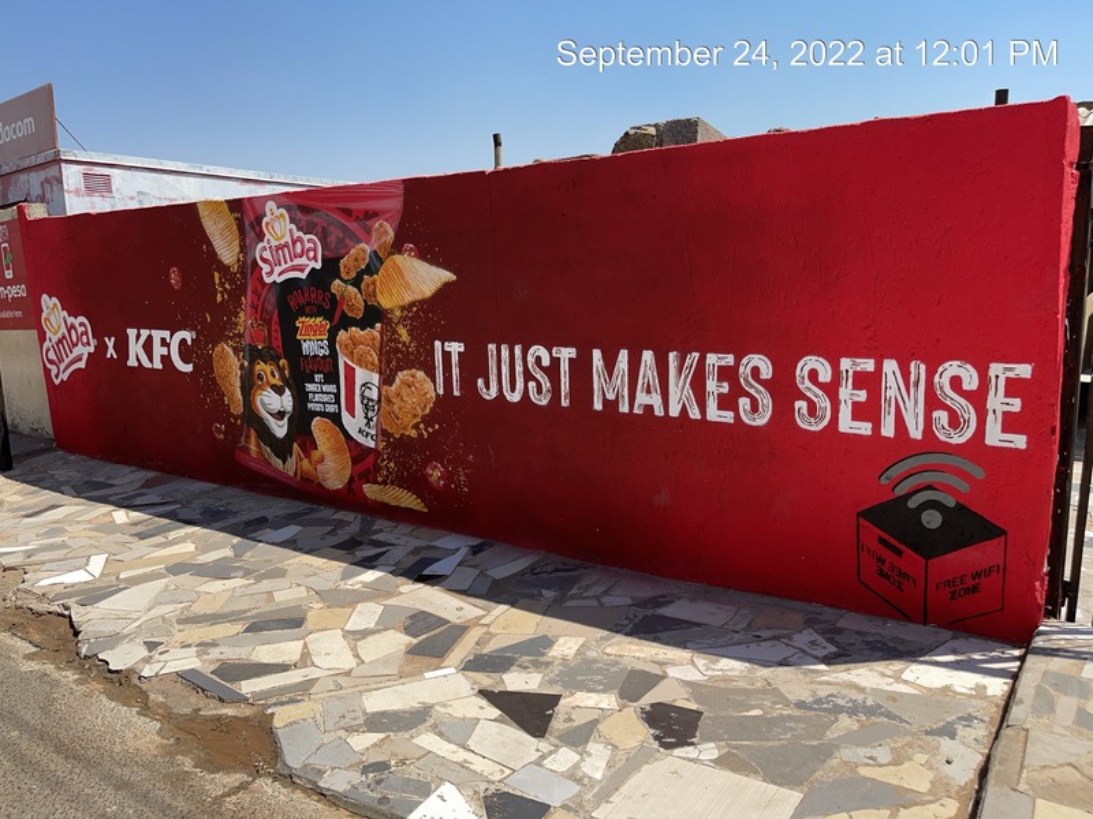
There's nothing that our team loves more than something spicy, and that's what Simba gave us.

The Media Krate team were dying to use our trademarked 3-dimensional visual reality airbrushing (3DVRA™) technique on Simba's advert for their new Zinger Wings flavoured chips. Getting the details right on the package is business as usual but the opportunity to make Simba's mane roar with realism was what our team took to heart. At The Media Krate we believe that the details are what make an advert an artwork. Our team use specialised tools to perfect the tiniest details and have an eye for colour that is unmatched in the industry. Take a look at your next brand campaign and ask yourself, should it have plain old adverts or does it deserve innovative artworks? If you answer is the latter then get in touch and let us bring your brand to life. Literally.

Breaking the 4th wall with The Media Krate’s WiFi enabled 3D sustainability/sustainable wall murals

Breaking the 4th wall with The Media Krate’s WiFi enabled 3D sustainability/sustainable wall murals

Township out-of-home (OOH) re-imagined.

Township advertising is finding its soul and evolving past the purely transactional, with “Purposeful Disruptors.” The Media Krate leading a transformation in South Africa’s OOH sector. By integrating public art and community values, we are shifting the focus from product features to human connection, creating a sustainable footprint within the township circular economy. “… us launching WiFi-Enabled 3D Sustainability Wall Murals, we are actively transforming community walls into purposeful, human-centric assets that solve real-world societal problems” says Kabelo Kale, strategic lead and head of operations Africa, at The Media Krate. A circular economy in the heart of the townships 3D sustainability wall murals are a move away from the unsustainable "take-make-waste" model, focusing instead on sustainability and township community empowerment. The murals are crafted from 100% recyclable/reusable materials and utilise plant-based, biodegradable paint, turning static advertisements into eco-conscious masterpieces. “ … This Township-Borne innovation and initiative fuels the Township Economy by providing permanent employment for reclaimers and wastepreneurs (A.K.A aboMgerezi), who play a vital role in the material lifecycle. In addition, by renting wall space from residents, the initiative turns township community members into "landlords," providing them with a consistent monthly income and playing a significant role in the socio-economic challenges facing township communities … " says Xolela Dubeko, head of communications and sustainability at The Media Krate. A human-centric connectivity “.. at its core, our innovation addresses the digital divide and augments digital distribution by integrating technology directly into the physical environment …” says Lorato Moroke, Strategic Lead and Head of Operations South Africa at The Media Krate. Each mural also serve as a Wi-Fi hotspot, granting residents much-needed internet access for education, job seeking, and much-desired social interaction. The hyper-realistic 3D designs and "glow-in-the-dark" elements ensure the murals are not just ads, but landmarks that ignite the senses and provoke community pride, and a tactile sense of presence, making environmental and social messages unignorable. Purpose-driven advertising brand alignment and social engineering For Advertising Brands, these murals offer a way to reach the South African majority consumer while achieving net-zero carbon reduction targets. By aligning with grassroots social impact, brands transition from being "advertisers" to "purposeful disruptors" who actively uplift the communities they serve. The Media Krate’s WiFi-Enabled 3D sustainability wall murals verifies that OOH media can be a powerful catalyst for social engineering, proving that a wall can be much more than a boundary or a parameter — it can be a bridge to a sustainable future.

Your dashboard is lying to you: Why brands keep missing the 1 trillion rands township economy

Your dashboard is lying to you: Why brands keep missing the 1 trillion rands township economy

Every quarter, somewhere in Sandton, a familiar ritual takes place. A marketing team walks into a boardroom armed with caffeine, confidence, and a deck so polished it could reflect poor judgement back at them. The plan is always dressed up nicely- buyer personas, programmatic media, predictive models, and stock photos of smiling township residents who have clearly never seen the campaign they are being used to justify.

Then the campaign goes live. The ads fire. The dashboard glows green. TikTok impressions do their little dance. Brand awareness behaves. Clicks arrive on time like obedient interns. Six months later, sales are still sitting in the corner, untouched and unimpressed. That is the ultimate South African corporate tragedy, "the expensive marketing joke". Brands keep spending millions measuring The What while ignoring The Why. They treat a living, breathing economy as a segmentation model to be optimised, then act surprised when the market refuses to behave like a PowerPoint shape. They win the retweets, collect the vanity metrics, get accidental product placement, and still miss the money. Congratulations: the campaign was loud, pretty, and commercially useless. The comfort trap of “The What” — Where strategy goes to hide “The What” is corporate comfort food. It is measurable, auditable, and easy to feed to regional headquarters without anyone choking on context. It is the landmark Billboard near Chris Hani Baragwanath Hospital, the translated headline with “Vilakazi Street” thrown in somewhere there, that one taxi-rank activation, the high-reach media buy, and the comforting illusion that visibility is the same as relevance. It is not. At best, it gets you noticed. At worst, it gets you ignored loudly. When brands chase “The What” without context, they develop a very expensive form of blindness. They see segments, not people. They see impressions, not intention. They see traffic, not trust. “The Why” Is where eeak strategies get exposed If “The What” gets your brand noticed, “The Why” decides whether anyone cares. It is the emotional, cultural, and economic logic behind how the majority market decides, spends, saves, shares, recommends, forgives, and rejects. Stokvels: Global models may reduce them to “micro-savings groups.” In reality, they are trust-based financial systems built on social accountability, collective resilience, and protection against inflation. Brand choice: A purchase is not only a price decision. It is a calculated investment of limited household "When a brand understands “The Why,” it can move from product status to cultural fixture. That is when a brand becomes household language." Table 1. Generic name status — Brands that earned cultural fixture status in the township household lexicon. Source: Kabelo Kale — Views from The Townships. These legacy brands did not become household shorthand through tokenism, cute slogans, or global campaigns dressed in local lipstick. They earned that place the difficult way: through consistency, availability, trust, and respect for the consumer’s budget and dignity. The uncomfortable truth is that very few, if any, brands have achieved that kind of generic-name status in the past 30 years. A few boardroom delusions that burn real money - and trust me, there are more! This is where strategy puts on a blazer, clears its throat, and starts lying with confidence. Smart people, clean data, global playbooks — and still, somehow, ideas that collapse the moment they meet a real shopper with real constraints. 1. The bulk-buying illusion The corporate fantasy: People buy large economy packs because they love discounts, have endless cupboard space, and plan household budgets like CFOs with grocery trolleys. The human reality: Bulk buying is often collective survival: a stokvel, an extended family pooling resources, or a household protecting itself against inflation, transport costs, and month-end uncertainty. The “consumer” in your model is often an entirenetwork. Your spreadsheet just failed to invite the aunties. 2. The premium spender paradox The corporate fantasy: Township consumers buying premium cars, luxury apparel, or status smartphones are reckless, irrational, or hypnotised by Western luxury culture. The human reality: When traditional wealth milestones are slow, blocked, or brutally expensive, visible quality becomes social capital. A premium purchase can signal dignity, credibility, ambition, and movement. Sometimes strategy wears good shoes — and sometimes the boardroom is too busy judging the shoes to read the strategy. 3. The digital leapfrog myth The corporate fantasy: High smartphone penetration means the market is ready for digital-only banking, AI chatbots, cashless e-commerce, and a frictionless future designed by people who have never run out of data before payday. The human reality: Digital usage is often defensive, not seamless. Data is expensive. WhatsApp works because it is familiar,predictable, and often zero-rated. Cash still matters because it gives immediate liquidity, avoids hidden fees, and lets households see exactly where every rand goes. Not everything broken needs an app. Sometimes the app is the problem. 4. The B-brand affordability fallacy The corporate fantasy: When money is tight, people will automatically switch to our cheaper B-brand. Simple. Elegant. Wrong. The Human Reality: Poverty is expensive, and mistakes are not cute when the budget is already bleeding. A failed product can wreck a tight household plan. Trusted brands often win because they feel like insurance against disappointment. 5. The energy drink myth The corporate fantasy: Energy drink sales are booming because township consumers are chasing elite performance, gym culture, and the global wellness aesthetic. Sure. And the taxi driver is training for a sponsored triathlon between routes. The human reality: Energy drinks are often endurance fuel, not fitness signalling. And yes, there are other reasons too — If you know you know, let’s just say score scored on this one! For commuters, taxi drivers, security guards, cleaners, and manual workers, they offer cheap, portable energy for long days where sitting down for a proper meal is a luxury the schedule did not approve. 6. The corporate sachet saviour complex The corporate fantasy: Let us copy the global sachet playbook and sell tiny packs to “unlock access.” Nothing says inclusion like charging more per millilitre. The human reality: Township consumers understand the poverty premium very well. Tiny sachets often cost more per millilitre than larger packs. Unless a sachet solves an immediate cash-flow problem, consumers may choose mid-tier house brands, bulk sharing, or communal buying. Access that quietly overcharges people is not innovation; it is math with bad manners. 7. The kasi-cool vernacular trap The corporate fantasy: Authenticity means grabbing slang from a trending TikTok, sending it through legal, and pretending the final sentence still has a pulse. The human reality: Street language changes fast and varies by place. By the time compliance has gently strangled the copy, the phrase is already stale. Consumers can smell pandering through the screen. Respect beats synthetic slang every time. 8. The boots-on-the-ground Sandton safari The corporate fantasy: Our executives did a one-day township immersion tour, so now we understand the market. There was a mural, a spaza visit, and lunch. Anthropology complete. The human reality: A curated township tour is not immersion; it is tourism with a research budget. Tinted SUVs, pre-briefed spaza owners, mural selfies, and a safe restaurant stop will not reveal the anxiety, logistics, negotiation, and improvisation that shape real commerce. 9. The always-on omnichannel delusion The corporate fantasy: Consumers are active on mobile, so let us build a heavy digital funnel with high-resolution video, banners, landing pages, and enough tracking pixels to qualify as surveillance cosplay. The human reality: A data-heavy funnel can feel like an economic penalty. Someone counting every megabyte is not admiring your unskippable video; they are watching their bundle vanish. That builds irritation, not brand love. 10. The CSR good corporate citizen hall pass The corporate fantasy: Donate a painted shipping container, add a ribbon-cutting photo, post it on LinkedIn, and wait for generational loyalty to arrive with the catering. The human reality: Communities know when CSR is just a branded billboard — especially in places like Soweto and Tembisa. If your product is overpriced, your distribution excludes local traders, and your strategy has the empathy of a parking ticket, a painted container will not rescue the quarter. 11. The taxi-rank activation overdose The corporate fantasy: Let us blast music at the taxi rank on Friday afternoon, hand out flyers, and call commuter irritation “engagement.” The human reality: A Friday afternoon taxi rank is not a brand playground. It is a high-pressure logistics system full of tired people counting fares, watching routes, guarding bags, and trying to get home. Your promoter is not a touchpoint; they are traffic. 12. The podcast bandwagon The corporate fantasy: Podcasting is booming, so let us sponsor a glossy studio show and pretend a 60-minute HD Vodcast is “mass market” because someone’s niece said podcasts are hot. The human reality: Podcast growth does not cancel data costs. Many consumers rely on workplace Wi-Fi or compressed clips shared on WhatsApp. A glossy HD vodcast may look premium in the agency case study while speaking mainly to a suburban bubble and missing the street entirely. Where the algorithm runs out of road and starts guessing Algorithms are brilliant at spotting patterns. They are less brilliant at understanding why cash feels safer than an app, why a grandmother will not switch washing powder, or why a cheap product can still feel financially dangerous. The model can tell you what moved. It cannot tell you what people are protecting. The linear-journey fallacy: Automated funnels assume people glide from awareness to purchase like obedient little dots in a presentation. Real buying journeys are social, messy, negotiated, payday-sensitive, route-dependent, and heavily shaped by who has already tried the product and survived the experience. The invisible informal economy: Formal analytics track card payments, banking logs, credit records, and retail scans. They miss cash moving through spaza shops, wholesalers, salons, local logistics, and buying pools. If there is no digital footprint, the model quietly pretends the money does not exist. Convenient. Also wrong. Contextual blindness: A model may label a local purchase spike as individual demand. On the ground, it may be a stokvel pooling money before prices rise, or households reorganising budgets before school-fees month. The data is not wrong; it is just lonely. Enter the human interface: Strategic hustler, the corporate mgerezi The answer is not to throw away the data. Relax. The dashboards can stay. They have feelings too you know, and finance still needs charts. The answer is to pair data with someone who can translate it through lived reality. That is the corporate mgerezi: the strategist who understands both the boardroom and the buying committee outside the spaza shop. Source: Views from The Township by Kabelo Kale. Dignity over demographics: The Corporate Mgerezi understands that consumers are not driven by survival alone. Pride, family obligation, aspiration, risk, and respect all shape how money is spent. Real-time bullshit detection: When an idea looks clever in the workshop but would be laughed off the street, the Corporate Mgerezi can challenge it before the budget is burned and the apology statement is drafted. Trust over friction: Corporate systems often treat cash, queues, handovers, and human contact as inefficiencies. In many communities, those “inefficiencies” are proof, control, reassurance, and trust in physical form. A reality check before the budget gets cremated Source: Views from The Township by Kabelo Kale. Before any campaign hits the market, every strategy team should sit down, breathe deeply, and ask five questions nobody in the room will enjoy: Are we solving a problem consumers actually named, or one we invented because it makes our product look useful? Is this behaviour aspirational, defensive, communal, practical, or all of the above? Did our insights come from real transactions in real environments, or from a focus group so sterile it could double as a clinic? Are we treating cash logistics and communal pooling as problems to remove, or trust systems to understand? Who in the room has enough lived proximity/empathy to challenge the comforting assumptions in this deck? Diagnostic framework by Kabelo Kale — Views from The Townships. So, who is the corporate mgerezi on your team? The Corporate Mgerezi is the person who can sit in a Sandton strategy session at 10:00, read the cultural weaknesses in the deck by 10:07, and explain by 10:12 why the idea will land in Mlazi or die quietly in the WhatsApp comments. They are not a mascot, translator, token, cultural ornament, or last-minute “please make this sound township” emergency contact. They are a serious strategist with commercial literacy, economic empathy, and lived proximity. They understand the boardroom and the buying committee around a kitchen table, in a taxi queue, or outside a spaza shop. Their value is translation at the exact point where strategy usually breaks - turning raw data into human context, calling out nonsense early, and making sure the consumer’s wallet and dignity get the same respect as quarterly targets. The future? Put a corporate mgerezi in the room before the room embarrasses itself True market intelligence lives between analytical rigour and cultural empathy. If your business relies only on models built far from the behaviours they claim to explain, you are not doing strategy. You are doing corporate astrology with better fonts and a procurement-approved deck. Table 2. The War Room Alignment Model — Embedding the Corporate Mgerezi alongside the conventional strategy stack. Model adapted from Kabelo Kale — Views from The Townships. The challenge is simple: stop treating the majority market like an entry-level segment to decode from a distance. It is not a lab specimen. It is a vast, complex economy to respect, study, and serve with humility. This ecosystem does not need pity. It demands respect — and it can smell condescension from a very long distance. The brands that win will not be the loudest, flashiest, or most over-produced. They will be the ones with deeper context, sharper listening, and enough internal courage to let someone in the room say the sentence everyone else is avoiding. "This looks beautiful on the deck, but it will not survive the streets.” So here is the brutal question for your leadership team: do you have a Corporate Mgerezi with real authority in the room, or are you still hoping your dashboard can explain what the streets already know?

The Media Krate launches S-OOH: The next era of outdoor starts where South Africa moves

The Media Krate launches S-OOH: The next era of outdoor starts where South Africa moves

The Media Krate launches S-OOH: The next era of outdoor starts where South Africa moves

If the commute is where South Africa moves, S-OOH is where brands stop watching from the pavement and start earning their place in the journey. - Kabelo Kale, strategic lead and head of operations Africa, The Media Krate Transit media did not need another extra-large poster. It needed a pulse, a point of view and the courage to stop behaving like rented wallpaper. Enter S-OOH, Spatial Out of Home by The Media Krate: a proprietary media innovation built to transform taxi ranks, markets and commuter economies from pass-through spaces into places brands can own, serve, electrify and belong. This is not rank branding with better lighting. It is a reset. S-OOH is designed around the daily choreography of the majority market: the wait, the walk, the queue, the hustle, the purchase, the route and the return. It understands that a taxi rank is not merely a media location. It is a marketplace with wheels, rhythm and influence. “Attention is rented. Belonging is built.” - Kabelo Kale, strategic lead and head of operations Africa, The Media Krate This is the heart of S-OOH: The Media Krate is not selling brands another media placement; it is inviting them to build meaningful presence inside the commuter economies that move South Africa. A taxi rank is not foot traffic. It is culture in motion. The Media Krate launches S-OOH as purposeful disruptors: not to make noise, but to make neglected media environments work harder, look better and mean more. Where traditional OOH sells surfaces, The Media Krate engineers presence. It reads commuter spaces as living systems made of infrastructure, commerce, culture, movement, memory and habit. That precision comes from The Media Krate’s specialist practice across township wall murals, township spaza branding, street-urban OOH, graffiti OOH and immersive brand escapes. These are not alternative media. They are proximity media: close to culture, close to commerce and close to the choices people make before the boardroom has finished calling them “insights.” Then comes the craft! The innovation and signature finishes, straight out of Kasi: 1. 3D HYPER REALISTIC AIRBRUSHING (3D VRA). 2. 3D SUSTAINABLE/SUSTAINABILITY AIRBRUSHING. 3. VISUAL REALITY HYPER-REALISM AIRBRUSHING. 4. GLOW-IN-THE-DARK AIRBRUSHING. 5. URBAN STREET WHEATPASTING. 6. URBAN STREET COMMERCIAL GRAFFITI. 7. URBAN STREET ILLUMINATED 3D BOXES. The result is out-of-home that refuses to sit flat: walls become theatre, entrances become landmarks, waiting areas become story points and commuter routes become brand journeys. The Launch Network: Four ranks, one spatial statement S-OOH launches across four strategic Gauteng commuter environments: Randburg Taxi Rank, Wanderers Taxi Rank, the Bara Perimeter Wall and Diepsloot Taxi Rank. Together, they create a launch map with reach and bite: commercial movement, urban pressure, landmark scale, township circulation and repeat commuter exposure. Randburg Taxi Rank brings the commercial charge: commuters, retail, services, workday movement and constant decision-making in one restless environment. Wanderers Taxi Rank adds velocity: office movement, city access and a commuter audience already in motion before the first headline has landed. Diepsloot Taxi Rank brings township-market muscle: local trade, repeat exposure, practical need and the kind of relevance no highway billboard can borrow. And this is only the opening act. The Media Krate already holds S-OOH space in KwaZulu-Natal at KwaMashu Bridge City, KwaMashu Crossing and Mnyandu Mall Umlazi, with more Western Cape locations to be announced. The platform is not built site by site. It is built as a network, route, region and market ecosystem. This is not a media map. It is a movement map. That is the S-OOH thesis in one sentence: stop renting attention and start building belonging. A brand should not arrive in a rank like a tourist with a media schedule. It should arrive with relevance, utility, craft and the confidence to become part of the environment. The launch framework makes that ambition tangible through four connected principles: Visible: landmark-scale presence that earns the commute instead of interrupting it. Useful: amenities, access and tools that give something back to the people who power the space. Dimensional: 3D, illuminated and hyper-realistic craft that turns surfaces into moments people notice, remember and share. Connected: Wi-Fi, digital tools and measurable engagement that move OOH beyond the old eyeball economy. Launched with Castrol South Africa The Media Krate launched S-OOH with Castrol, a forward-thinking brand with a clear ambition: to dominate and engage commuters, taxi operators, drivers, mechanics and spares-counter decision-makers in the very spaces where mobility is not a metaphor; it is the business model. This is Castrol moving from media presence to market presence: from being seen to being useful, from visibility to authority, from campaign placement to commuter relevance. And a resounding encore is due to Rorisang Shuping at Castrol, for trusting The Media Krate to bring her bold vision to life. For brands, S-OOH delivers more than awareness. It offers spatial ownership, repeated commuter exposure, high-impact visual craft, digital engagement opportunities and contextual relevance inside the environments where mobility, trade and daily decision-making collide. For brands ready to stop decorating the commute and start shaping it, this is the invitation: partner with The Media Krate to build S-OOH environments that do more than reach audiences. Own the space. Earn the moment. Build where people move, wait, buy and decide. S-OOH is not a category extension. It is a category correction. The Media Krate is not asking brands to buy more outdoor. It is challenging them to think harder about where influence actually lives, and then build there with intelligence, audacity and respect across the commuter economies that move South Africa. And The Media Krate is not done. S-OOH is only the first signal of what is coming next: more spatial formats, sharper commuter intelligence, deeper market integrations and new ways for brands to move from being seen to being felt. The next innovations are being built for the spaces traditional media still misunderstands, and for the brands bold enough to get there FIRST! In the end, S-OOH is more than a media launch. It is The Media Krate’s love letter to the places that carry South Africa every day: the ranks, routes, markets, walls and waiting spaces where people hustle, connect, repair, trade, commute and dream out loud. Launched with Castrol across high-impact Gauteng environments, S-OOH gives brands a new way to show up with presence, purpose and cultural intelligence - not above the market, but inside its heartbeat. The rank is no longer just where the journey begins. It is where the next era of brand influence arrives. #TheMediaKrate #SOOH #SpatialOOH #PurposefulDisruptors #TaxiRankMedia #TownshipOOH #KabeloKale #UrbanStreetOOH #CommercialGraffiti #SpazaBranding #3DHyperRealism #GlowInTheDarkAirbrushing #UrbanStreetIlluminated3DBoxes #Castrol #RandburgTaxiRank #WanderersTaxiRank #BaraPerimeterWall #DiepslootTaxiRank #KwaMashuBridgeCity #KwaMashuCrossing #MnyanduMall #Umlazi #GreenInnoation #DisruptiveOOH

Outside the brief

Outside the brief

The preferred list was supposed to be a door. For too many South African media owners, it has become a wall.

Anyone who has worked in South African out-of-home (OOH) long enough knows the moment. A strong idea lands on the table. The location is right. The audience insight is sharp. The permissions are possible. The media owner or media operator understands the environment because they work in it every day. A brand manager says, with complete sincerity, that the campaign must “meet South Africans where they are.” The room leans forward. Then procurement asks: “Is the supplier on the preferred list?” The room leans back. Not because the idea is weak, but because it must now clear a wall before anyone may judge it on merit. That wall has three names: the preferred-supplier list, the preferred media-owner panel and the preferred-agency framework. Each can be a sensible governance tool. Stacked together and left closed, they decide in advance whose innovation gets seen and whose is filed under “non-compliant.” Let it be said plainly: this is not a hit piece, nor an attack on the agencies, networks or media owners currently winning work inside these frameworks. Many are excellent at what they do, and no one needs to apologise for being on a preferred list. The argument is with a system that has narrowed around them. The question is simple: does the list still manage risk, or has it begun to manage possibility out of the plan? That narrowing carries a real cost. South Africa’s township economy is widely estimated to be worth more than R1tn a year. This is not a niche, nor an emerging market waiting to be discovered. It is the mainstream economy for millions of people, with its own landmarks, rituals and languages of attention. Yet much of the system controlling formal media spend still treats township relevance as something to be visited, translated and validated from the outside. Source note: The R1trillion figure is an indicative scale marker; township-economy estimates vary by methodology. How the funnel narrows Preferred frameworks begin with good intentions. Brands want vetted partners, predictable pricing and audit trails. Procurement wants compliance. Legal wants recourse. Nobody enters the room announcing a plan to exclude innovation. The problem is what happens next. Exclusion arrives by accumulation: one reasonable safeguard placed upon another until the system rewards whoever is best at paperwork rather than whoever is best at media. The panel becomes a closed loop – the same names, reviewed by the same committees, against criteria that can sit far from the realities of briefing a mural in Katlehong or negotiating site access with a taxi association in Randburg. The filtering can start before the idea has even had a fair hearing. We receive a prescribed briefing template to complete before our sites may be considered, written as though every valuable media environment can be understood through the same fields. God bless the media owner or media operator whose site is rich in audience knowledge, access and cultural value but short on the particular detail the template has decided is intelligence. The idea may be right for the street and wrong for the spreadsheet – and too often, the spreadsheet gets the final word. At that point, the logic reverses. Instead of starting with the audience and asking which medium reaches them best, the planner starts with the approved vendor sheet and asks which vendor can be stretched to fit the brief. That is no longer audience-led strategy. It is inventory management presented as planning discipline. Once the list becomes the measure of safety, everything beyond it is treated as risky by default. A township-based operator with original sites, community consent, insurance and a clean installation record may have to justify itself as though it were untested, while an incumbent with a familiar logo benefits from trust already built into the system. Exclusion by procedure, not by intent This is how a neutral-looking system produces an unfair result without ever declaring an unfair intention. Heavy paperwork, unannounced admission windows, opaque scoring and multi-year renewal cycles may not exclude deliberately, but they can exclude effectively. A small, inventive OOH owner in Diepsloot or Khayelitsha does not employ a bid office to translate a tender into legal, financial and compliance dialect. They have a phone, a working relationship with a rank chairman, a public-liability policy and a reputation that took years to earn in a community that does not hand out second chances. When the admission process is calibrated to the capabilities of a holding-group company, it silently disqualifies everyone who is not one. The media owner or media operator may be excellent, the sites exceptional and the audience exactly right, but the format of the application filters on something that has nothing to do with media quality. Opacity carries another risk that should be named without accusation. When criteria are unpublished, renewals unexplained and panels permanently closed, the system becomes harder to audit and easier to mistrust. Transparent rules protect honest people inside the process, protect the client, and cost far less than reputational damage. The visible result is sameness. Every plan begins to resemble the last one: same formats, same locations, same metrics. Innovation rarely dies in a boardroom vote. It dies in an email that reads, “Unfortunately, this supplier is not on the panel.” The validation tax Procedure is only one part of the problem. The other is validation. Frameworks presented as neutral are often calibrated to imported standards. A European or North American methodology, a global behavioural template or a familiar dashboard arrives pre-approved; a local media owner or media operator who invented a format because the audience demanded it arrives as an experiment. Call it the validation tax: the surcharge an idea pays for not having been approved somewhere else first. A locally engineered format designed for South African streets may have to explain its legitimacy before anyone measures its effect, while a familiar imported platform often arrives with credibility already attached. The issue is not whether imported tools have value. It is whether local proof is forced to work harder than foreign precedent. Local agencies using imported behavioural templates can also benefit from this structural advantage. Their offerings pre-qualify because the standards were written around them. The framework looks neutral and plays like a home fixture. None of this is a rejection of global learning. The problem begins when imported validation becomes more credible than local proof, even in environments where local media owners and media operators understand the audience, the space and the operating conditions better. What gets lost on the street For clarity, S-OOH refers here to spatial out-of-home: media designed around the specific ways people move through public, commercial and community spaces, rather than around inventory categories alone. Its value lies not only in visibility, but in how well the format understands the behaviour, rhythm and social rules of the place it occupies. What gets lost in that translation is South African out-of-home at its most original. This is not a downgrade from mall and highway media or other traditional outdoor formats. It is a category in its own right, built around how people actually move through South African space. Taxi ranks, station precincts, spaza walls, car washes, barber shops and high-street foot traffic are not secondary locations. For millions of South Africans, they are among the primary attention environments of the day. Some local media owners and media operators have already shown what this can look like on the ground: multisensory murals people stop to touch and photograph, lenticular work that changes message depending on where you stand, installations that respect commuter flow, keep wheelchair paths clear and are still maintained long after the launch photographs are filed. That is not decoration. It is engineered cultural relevance. Yet formal buying processes still classify this work as “alternative,” “niche” or “below-the-line.” The vocabulary becomes the verdict: work made for the street matters less than work made for the highway. That is not a finding. It is a habit, and habits can be retired. When the ignored becomes undeniable We have seen a version of this pattern before. Stokvels were once treated by formal financial institutions as informal, even faintly suspicious – something happening beyond the reach of “proper” financial services. Then the scale of money moving through them became harder to ignore, and the conversation changed. Stokvels did not become legitimate because anyone generously included them; formal markets were forced to recognise what communities had understood all along. Township and street OOH is on the same trajectory. The audiences were always there. The spending power was always there. What changed is that a few brands decided to look past the stigma. Work by brands such as Castrol and MTN across taxi ranks, car washes, informal mechanic spaces and auto-spares sites matters here not as name-drops, but as proof points. Those examples showed that these spaces are not inherently too complex, too informal or too risky for serious brand investment. When the operating model is respected, funded and measured properly, the so-called alternative environment becomes a mainstream OOH channel. The lesson is not that every street-level idea should be approved automatically. It is that familiar discomfort should not be mistaken for strategic risk. Outside the preferred list, there is more. More reach. More cultural precision. More trust. More formats that people actually notice. Accessibility and utility are qualifiers, not garnish Recognition, however, is not enough. If street-level OOH is to move into the mainstream, two qualities must move with it from the margin of the template to the centre of the decision: accessibility and public usefulness. Any plan that claims national relevance has to work for everyone who uses the space. Ramps, sightlines, tactile elements and safe pedestrian flow are not enhancements; they are conditions of entry. A campaign can carry world-class creative work and still fail a basic test of public communication if a wheelchair user cannot approach it safely at a taxi rank. Many strong local media owners and media operators already build toward this standard. Preferred frameworks should require it, and should score it. OOH can also solve problems while it communicates. In townships where waste management is a daily pressure, a site can do more than carry a message: it can support responsible disposal, waste separation, collection or public education, provided the solution is designed with the community and the people responsible for maintaining it. Sustainable wall murals can reduce material waste, use lower-impact production methods, create local work and leave the site better than it was found. That is media delivering value twice – once for the brand and once for the place hosting it. That broader value is exactly why the template has to change. A framework built mainly around dimensions, traffic counts and CPM, the cost-per-thousand metric that still dominates many media-buying decisions, cannot properly score accessibility, environmental design, maintenance or measurable community benefit. It should not demand that an idea become conventional before it can be considered credible; it should create room to test whether the idea works. What narrowness costs the client This narrowness eventually lands on the client’s balance sheet. The cost appears in three places: missed audiences, weaker ideas and false efficiency. First, the brand loses coverage because approved inventory does not reach every market that matters. The township economy is not mysterious; it is under-represented in too many formal planning and procurement systems. Second, the brand loses competitive tension. When the same few vendors rotate through too many briefs, there is little incentive to propose anything new. Planning becomes a spreadsheet routine – compare CPMs, select an approved option, sign off – and creativity is reduced to a rounding error. Third, the brand can mistake low cost for strong performance. CPM matters, but it does not measure dwell, recall, cultural relevance, community response or whether the work entered a local conversation. An impression that leaves no memory, no action and no local relevance is not efficient simply because it was cheap. Doors, not walls The answer is not less governance. It is better governance – procurement that serves the brief instead of shrinking it. Five decisions can begin now: reserve a meaningful test budget, publish the rules, open admission windows, fast-track credible pilots, and broaden the scorecard beyond CPM: Ring-fence at least fifteen percent of every OOH budget for credible boutique, regional and township partners that meet safety, permissions, insurance and delivery requirements. This is not charity; it is a planning discipline that brings overlooked audiences and ideas into the room while still protecting the client’s standards. Publish admission requirements, scoring criteria and fixed renewal dates. Open applications regularly and give every qualifying media owner or media operator a decision within thirty days. Create a fast-track pilot for formats outside existing categories that can demonstrate relevance, reach, safety and operational readiness. Give the idea a controlled opportunity to prove itself before a template rejects it. Require conflict-of-interest declarations, independent review and transparent reporting for every preferred agreement. Then broaden the scorecard. Measure more than CPM: recall, dwell, cultural relevance, accessibility, sustainability and practical community value. None of these changes weakens governance. They make it more intelligent. Procurement should protect the strategy, not quietly become the strategy. At the next OOH briefing, every client and agency can ask one decisive question before opening the approved vendor sheet: who is the audience, and who understands that audience best? The bigger opportunity That question opens a larger opportunity. South African media does not need to import its next chapter; it needs to fund the people already writing it. The township, the street, the taxi rank, car washes, township wall murals and the spaza walls are not fringe media. They are the front line of daily life for millions of people across the country. Brands that work there with respect, operational rigour and genuinely local creativity can build equity no imported dashboard can replicate. Preferred lists are not the enemy. They should be doors rather than walls: firm enough to protect standards, open enough to admit excellence. When they exclude suppliers without testing their ideas, they also exclude audiences, relevance and growth. The opportunity is already being built — in public, locally and at street level ~ Kabelo Kale The next South African media boom is not waiting in a global template. It is already being built in the routes, ranks, walls and gathering places that shape daily life. The opportunity is at the door. Our systems must now decide whether they are designed to recognise it. Open the gates. Back the builders. Fund the culture.

New articles are published regularly — get in touch to be notified.

Let's get social

Say hello

Get in Touch

011 100 9830 info@themediakrate.co.za

24 Achter Road, Paulshof, Sandton